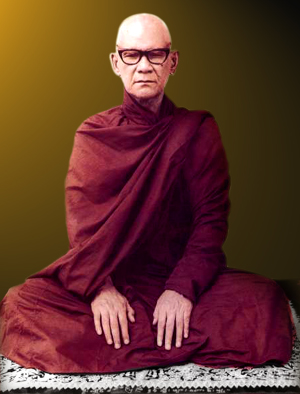
Venerable Mahasi Sayadaw U Sobhana
Full Name: Maung Thwin
Dhamma Name: Sobhana
Practice: Theravāda, Mahāsi tradition
Born: July 29, 1904
Passed away: August 14, 1982
Biography
Mahāsi Sayadaw was born Maung Thwin on July 29, 1904 in Seikkhun village, Shwebo District, British Burma. He became a novice at the age of twelve and was ordained at age twenty, adopting the religious name Sobhana.
Over several decades, he studied deeply in the Buddhist scriptural tradition and passed the rigorous series of government examinations. In 1941 he earned the title Dhammācariya (teacher of Dhamma).
In 1931, he left his teaching post in Moulmein and went to Thaton to engage in intensive vipassana meditation under Mingun Jetawun Sayadaw (U Nārada). He first began teaching insight meditation in 1938 in his home region at a monastery named “Mahāsi,” and from there became widely known as Mahāsi Sayadaw.
In 1947, Prime Minister U Nu invited him to become resident teacher at a newly established meditation center in Yangon, which later became known as Mahāsi Sāsana Yeiktha. He also served as questioner and final editor in the Sixth Buddhist Council (1954).
Mahāsi Sayadaw established meditation centers across Burma and internationally. By 1972, his network of centers had trained over 700,000 meditators. In 1979 he traveled to the West, leading retreats in places such as the Insight Meditation Society (Barre, Massachusetts) in the U.S.
He passed away on August 14, 1982 in Rangoon, Burma. His cremation was attended by thousands of disciples, even during heavy monsoon rains.
Practice
Mahāsi’s method is rooted in the Satipaṭṭhāna Sutta: one begins by strengthening morality (sīla) to support meditation. The practitioner then engages in mindfulness of breathing (noticing the rising and falling of the abdomen) and pays attention to any arising mental or physical phenomena.
In this noting process, one refrains from engaging in further conceptual thinking and instead observes phenomena as they arise and pass. This is paired with reflective insight into the Buddhist teachings of causation, enabling insight into impermanence (anicca), suffering (dukkha), and non-self (anattā).